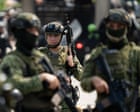
High Stakes in Iraq’s Push to Reclaim Jurf al-Sakhar pfranz Fri, 11/20/2026 - 20:40 Latest Updates Africa Asia-Pacific Europe Latin America & Caribbean Middle East & North Africa United States Global Issues & Institutions My Reading List Iraqi soldiers deploy in Jurf al-Sakher, in Babil Province, on November 20, 2026. AHMAD AL-RUBAYE / AFP Q&A / Middle East & North Africa 20 November 2026 8 minutes High Stakes in Iraq’s Push to Reclaim Jurf al-Sakhar On 20 November, Iraqi government forces entered Jurf al-Sakhar, a stronghold of the Iran-backed group Kata’ib Hizbollah. In this Q&A, Crisis Group expert Lahib Higel explains the circumstances that allowed Prime Minister Ali al-Zaidi to restore state authority in this area. Share BlueSky Email Facebook Linkedin Twitter Whatsapp Save Print Lahib Higel Deputy Program Director, MENA https://twitter.com/LahibHigel Related Tags Iraq What is happening in Jurf al-Sakhar? In mid-November, tensions escalated between Prime Minister Ali al-Zaidi’s government and Kata’ib Hizbollah, an Iran-aligned armed faction, over control of Jurf al-Sakhar, a town on the Euphrates River in Babil governorate about 60km south west of Baghdad. The trigger was an intelligence report alleging that oil has been illegally extracted from pipelines passing through the area and transported to Baghdad for sale. The report suggested that this illicit activity has been taking place since 2021. Zaidi ordered an investigation, and a government committee entered the area on 13 November. It was led by the Hashd al-Shaabi, also known as the Popular Mobilisation Forces, an institution comprising volunteer armed groups that combined to fight ISIS in 2014. The committee also included representatives of the prime minister’s office as well as senior figures from various state bodies. The government subsequently announced that investigators had uncovered evidence of oil smuggling and unauthorised refining, prompting the prime minister to dismiss nine top security and oil sector officials for negligence. His government also publicly accused Kata’ib Hizbollah of involvement in the racket, allegations that the group rejects , claiming the investigation was politically motivated and aimed at compelling it to surrender its weapons. For the prime minister, the episode offered a prized opportunity to restore state control of Jurf al-Sakhar, which has been beyond the reach of successive governments since 2014. He ordered state forces to enter the area and set a 20 November deadline for Kata’ib Hizbollah to withdraw. The government sent reinforcements to Jurf al-Sakhar’s vicinity, and on 19 November the prime minister’s spokesperson issued a statement identifying the forces that were to occupy the area. These included Iraqi army units, federal police, energy police and two Hashd brigades. Zaidi’s move proved successful. On 20 November, state forces entered Jurf al-Sakhar, following a deal in which Kata’ib Hizbollah agreed to partially withdraw its fighters and redeploy them elsewhere. That said, questions remain regarding the government’s ability to exert its authority over the area and the degree to which Kata’ib Hizbollah will retain influence there through the Hashd, of which it is a member. Why is Jurf al-Sakhar so important? Jurf al-Sakhar is a sub-district of Babil province, bordering Anbar and Baghdad provinces. It sits on an important route leading to Karbala, one of Iraq’s two Shiite shrine cities. The area became an ISIS stronghold in 2014, until state forces and armed groups that mobilised under the Hashd recaptured it in October of that year, displacing thousands of families. The recapture of Jurf al-Sakhar had huge symbolic weight for Shiite forces, as it was one of the first areas from which they were able to expel ISIS. It also halted the jihadist group’s advance toward Karbala. The Hashd later renamed it Jurf al-Nasr (Victory Cliff), though not everyone enjoyed the fruits of victory: the battle for the area proved devastating to its predominantly Sunni population, which was forced to flee and barred from returning. Twelve years later, some 100,000 of the residents remain displaced . The duration and extent of mass displacement from Jurf al-Sakhar are unique among areas recaptured from ISIS, and the armed groups that took charge in 2014 have never previously turned it back to regular state forces. Jurf al-Sakhar was transformed into a sort of private militarised haven. In recent years, Kata’ib Hizbollah became the main authority there. The area provided the group with a strategic bastion where it maintained a large degree of autonomy. Prior to the fall of the Assad regime in neighbouring Syria, Kata’ib Hizbollah used Jurf al-Sakhar as a conduit for arms transfers from Iran to Syrian forces; the town is also where the group started manufacturing its own weapons, including drones. What drove the government’s confrontation with Kata’ib Hizbollah? The official justification was the investigation into alleged oil smuggling. But the clash stemmed in large part from Zaidi’s bid to strengthen the Iraqi state’s writ and bring armed factions’ independent command structures and weapons under government control. His move to take back the area has a domestic payoff, demonstrating to the Iraqi public that they have a prime minister willing to make highly controversial decisions. Foreign pressure also likely shaped Zaidi’s calculations. Washington has repeatedly urged Baghdad to curb the influence of Iran-aligned armed groups and their economic networks. Since taking office in May, Zaidi has sought to make progress on integrating autonomous armed groups and disarming those that refuse to come under state command. Following the withdrawal of U.S.-led coalition forces on 30 September, he outlined a nine-month disarmament plan. Most armed factions said they were willing to negotiate their status with the government and bring their weapons under central state authority. Two – Kata’ib Hizbollah and Harakat al-Nujaba – resisted. Relations between Zaidi and Kata’ib Hizbollah have been particularly fraught. Relations between Zaidi and Kata’ib Hizbollah have been particularly fraught. The group entered preliminary negotiations with the government, but rejected the prime minister’s plan in October. Tensions rose in early November when Zaidi cancelled service contracts at Mosul airport reportedly linked to armed groups, including Kata’ib Hizbollah, which in turn accused the prime minister and his family of corruption. According to media reports that cited leaked judicial documents, an arrest warrant was issued for the son of Kata’ib Hizbollah’s leader. The oil smuggling allegations provided Zaidi with the legal justification to take action against the group’s de facto enclave. They also allowed him to attack Kata’ib Hizbollah at its weakest spot, namely the issue of public resources and corruption, rather than that of weapons – a more sensitive matter that the group would almost certainly have resisted from the outset. The prime minister’s overarching goal was not lost on the group’s leaders, but they calculated that it would be hard to challenge Zaidi’s anti-corruption campaign, which several political leaders endorsed at the start of his premiership. Throughout the dispute with Kata’ib Hizbollah, Zaidi has sought judicial backing for his actions, aiming to portray the fight as a law enforcement matter rather than a political dispute. On 15 November, he met Supreme Judicial Council President Faiq Zaidan to discuss the oil smuggling investigation and possible legal measures against those implicated. Two days later, a judicial investigative committee entered Jurf al-Sakhar to look into any violations and inspect the sites identified in the intelligence report. Zaidi’s gambit was not without risk, as Kata’ib Hizbollah could have dug in its heels, daring the prime minister to resort to force. Past episodes offer cautionary tales as to the outcome of such armed confrontations. In June 2020, government forces arrested fourteen Kata’ib Hizbollah members suspected of preparing rocket attacks, yet most were released within days following an armed mobilisation against the government. More recently, Zaidi’s own efforts to assert control of armed factions faced resistance, including an unsuccessful attempt to seize weapons from Harakat al-Nujaba in Baghdad in July. Moreover, Kata’ib Hizbollah was well aware that, in the past, Zaidi had made ambitious commitments from which he was forced to backtrack. He first pledged to disarm the groups by 30 September, only to extend the deadline to 30 June 2027 following pushback from hardline factions calling themselves the Islamic Resistance, including Kata’ib Hizbollah and Harakat al-Nujaba. How did Iraq’s Shiite political and armed factions respond? The confrontation exposed differences within the Shia Coordination Framework, the coalition supporting Zaidi’s government. All the Framework leaders were alarmed by the prospect of a battle between the state and the armed groups, fearing it could trigger intra-Shiite strife. Some appeared more open to taking the risk, believing that prior governments had been too cautious vis-à-vis the armed groups. Former Prime Minister Nouri al-Maliki – who deployed troops to dismantle the Jaysh al-Mahdi armed group in 2008 – was one of those who seemed amenable to the use of force, at least as a last resort. Others, notably some linked to armed groups that had resisted the U.S. occupation, were more reluctant to threaten the use of force. One such person was Hadi al-Ameri, who heads both the military and political wings of the Badr Organisation. Differences aside, Framework leaders closed ranks in seeking to mediate between Zaidi and Kata’ib Hizbollah, with Ameri, Maliki and Humam Hamoudi, head of the Islamic Supreme Council of Iraq, all playing a part. The three endeavoured to convince Kata’ib Hizbollah to exit the area peacefully, advocating for the group’s gradual withdrawal in conjunction with the deployment of government-aligned forces, including Hashd units not affiliated with Kata’ib Hizbollah. Kata’ib Hizbollah itself appeared somewhat divided. The group’s competing leadership networks – including those associated with its secretary-general, Abu Hussein al-Hamidawi, and those tied to Abdulaziz al-Mohammadawi, also known as Abu Fadak, who serves as the Hashd chief of staff – disagreed over the idea of withdrawal. Both rejected the government's allegations and maintained that the group needed to retain its weapons independently of the Hashd for the sake of Iraq’s defence. But, according to media reports, Abu Fadak favoured an agreement that would allow government forces alongside Hashd brigades to assume control of parts of Jurf al-Sakhar. In contrast, Hamidawi opposed any concession and allegedly proposed delaying a handover until June 2027, likely believing that Zaidi lacked the political backing to follow through on his threats and that other Shiite leaders would restrain him. Importantly, Iran stepped in to contain the confrontation. Zaidi made a brief, unannounced visit to Tehran on 6 November, during which he met Iranian President Masoud Pezeshkian and parliamentary speaker Mohammad Baqer Qalibaf. His meetings reportedly focused on Iraq’s efforts to mediate between Washington and Tehran, though it came amid growing U.S. pressure on Baghdad to rein in Iran-aligned armed groups. Ten days later, on 16 November, Esmail Qaani, commander of the Revolutionary Guards’ Qods Force, arrived in Iraq for discussions with Shiite politicians and armed factions, including representatives of Kata’ib Hizbollah. His efforts reportedly centred on avoiding a military confrontation between Kata’ib Hizbollah and the Iraqi government, partly by devising an off-ramp that would entail concessions by the group. What does the negotiated settlement look like, and are there risks of escalation? Withdrawal has been partially achieved without a flare-up of violence, which is no small achievement for Zaidi and the mediators. Broadly speaking, the deal entails legal action against those implicated in oil smuggling, Kata’ib Hizbollah’s formal withdrawal from Jurf al-Sakhar and transfer of control of the sub-district to four bodies – the Iraqi army, federal police, counter-terrorism service and Hashd – each of which is responsible for a separate geographic area. In addition, energy police have been deployed to secure oil pipelines in Jurf al-Sakhar. Questions remain, notably over the scope of Kata’ib Hizbollah’s withdrawal. In particular, it is unclear whether Kata’ib Hizbollah will leave the central area where the 72nd and 79th Hashd brigades have been deployed – or remain there under Hashd cover. Even were Kata’ib Hizbollah to fully withdraw, it is also unclear how the prime minister will view a continued role for the Hashd in the long term. Will he consider the replacement of Kata’ib Hizbollah by other Hashd brigades as an acceptable solution? Or will he see it as essentially redistributing influence over parts of Jurf al-Sakhr without touching the underlying problem of lack of effective government oversight? The outcome to date is cause for satisfaction in the Iraqi government. But a more sustainable solution, and one more consistent with the government’s agenda, would need to clarify the chain of command, establish full government control of the sub-district and facilitate the return of its displaced residents. Related Tags More for you Commentary / Middle East & North Africa The U.S.-led Anti-ISIS Coalition is Leaving Iraq: What Happens Next? Also available in Arabic Video / Middle East & North Africa Iraq’s Post-coalition Test
Geopolitics
geopoliticsconflictdiplomacyanalysis